Almond Data

Explainable, QA-gated data products for analysts, researchers, and builders.

Low-noise cadence. No spam. Paid products are delivered via secure, expiring links.

Now shipping
Data product
Credit Stress Index (US)
State × month • monthly • versioned releases
See details Docs

Products

Small, focused datasets shipped like real software. Versioned, QA-gated, and documented.

Now shipping

Credit Stress Index (US)

A monthly, state-level view of credit and financial stress. Built to be explainable, auditable, and safe to operationalize.

Markets move fast. State economies don’t move in sync. If you’re tracking macro, housing, or consumer credit, you often need a simple way to answer. Which states are getting worse, and why?

If you track macro, housing, or consumer credit, this gives you a consistent monthly view of stress by state, plus the drivers behind the moves.

See the story in one minute

Credit Stress Index is a 0 to 100 score where higher means worse. It updates monthly for every state plus DC. Use it to compare states over time and see what is driving the change. Every release is versioned and includes QA checks, data quality reporting, and integrity checks so you can use it without guessing what changed.
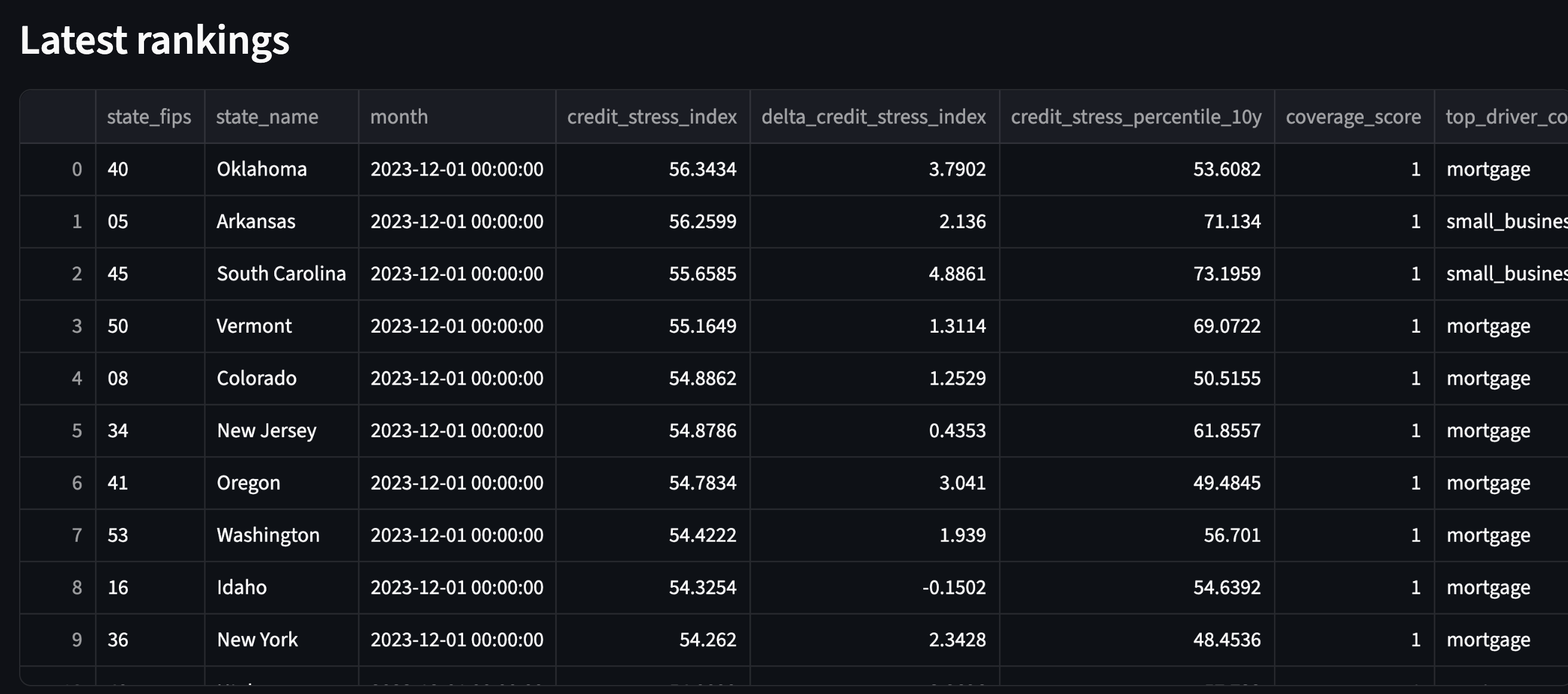
Latest rankings table screenshot
Latest rankings
See what’s happening now

A latest-month leaderboard that answers a simple question. Which states look most stressed today?

Pro tip. Start with coverage_score >= 0.75 so you compare like with like.
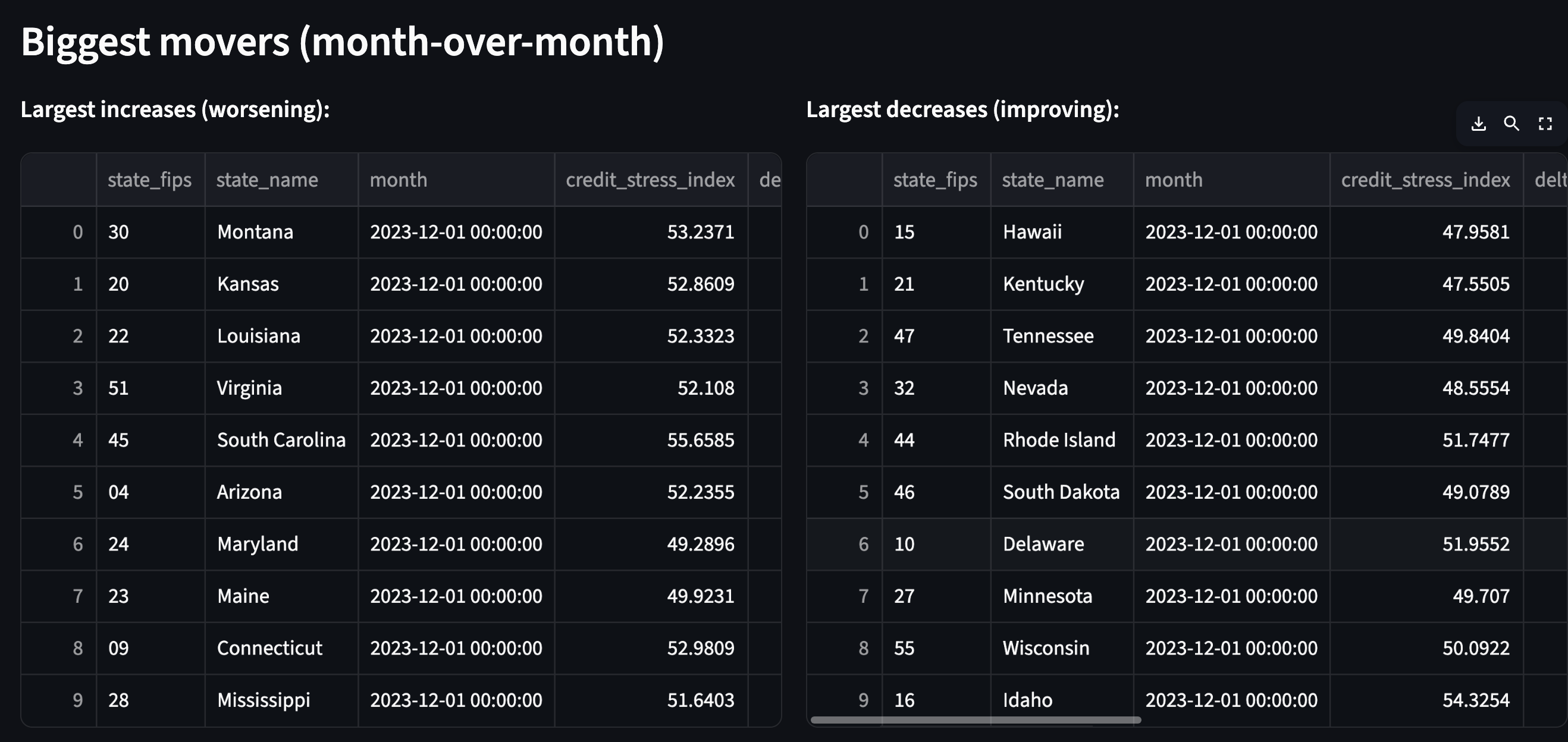
Biggest movers month-over-month screenshot
Biggest movers (month over month)
Spot momentum (what changed vs last month)

Track month-over-month movement with delta_credit_stress_index (this month − previous month). Positive means worsening. Negative means improving.
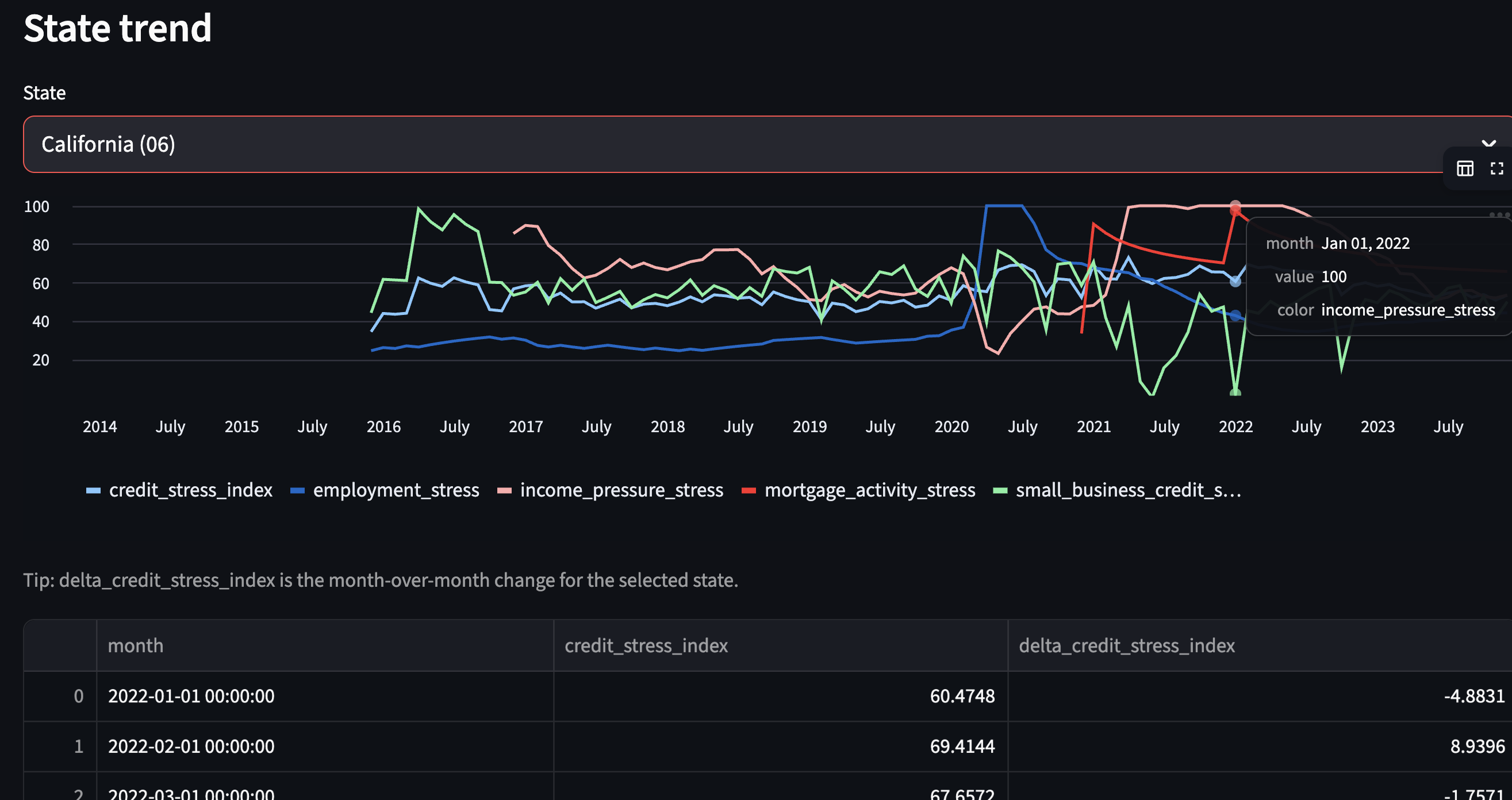
State time series trend screenshot
State trend over time
Tell the story over time

A state time series with the index and its components. It also includes deltas for the last 24 months, which is great for notes, briefings, and dashboards.
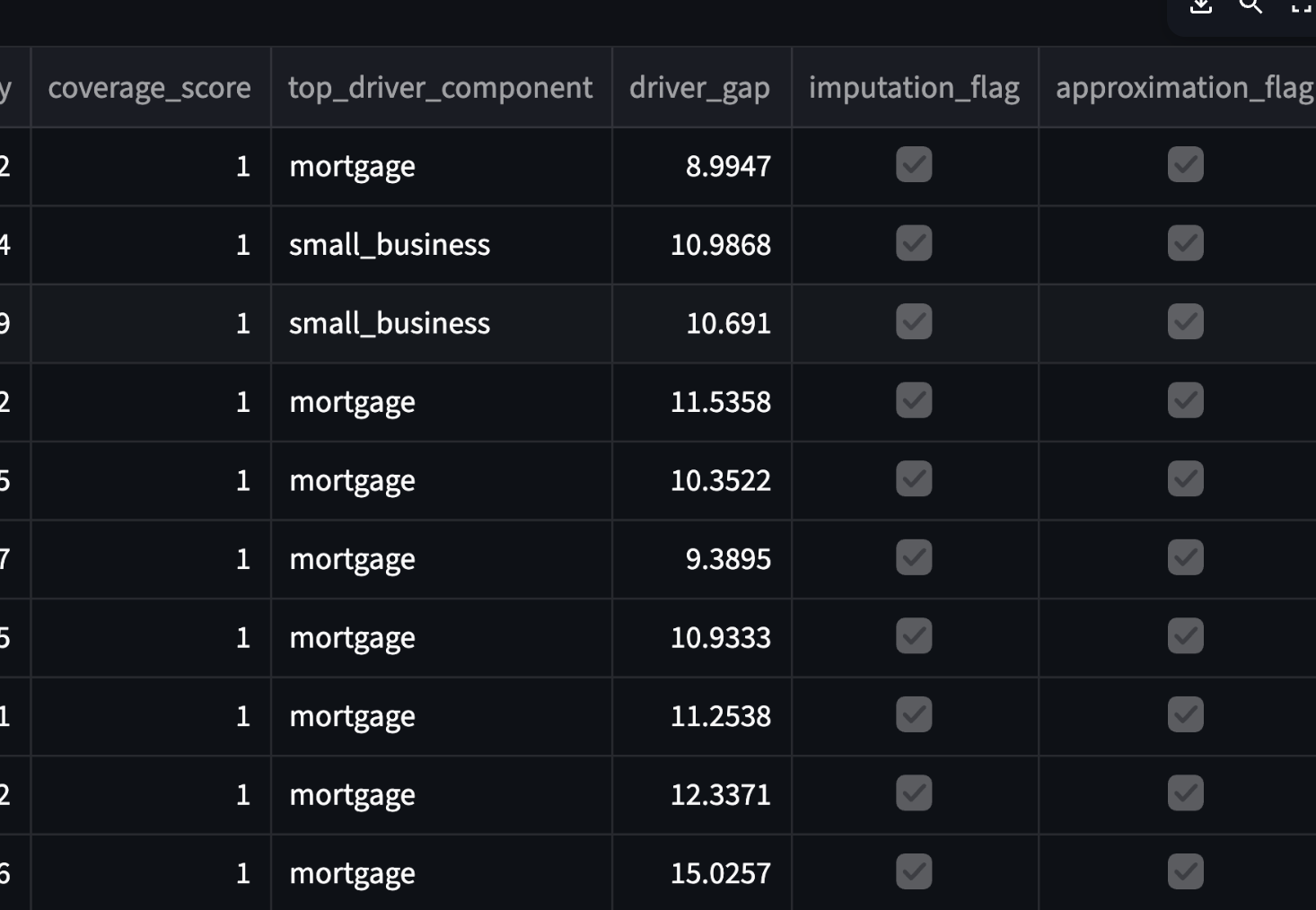
Coverage score and flags screenshot
Coverage and quality flags
Built to be safe to operationalize

Every row includes coverage_score plus quality flags, so you can filter intentionally.

  • imputation_flag = frequency expansion/fill (e.g., quarterly→monthly)
  • approximation_flag = proxy/replication
Starter playbooks

Representative workflows. These are not customer testimonials. Copy them into your process and adapt.

Playbook
15-minute monthly brief

Where is stress highest, what changed, and what’s driving it?

  1. Open Rankings (latest month).
  2. Check Movers (month-over-month change).
  3. Explain with components + top driver (and note coverage/flags).
Playbook
Monitoring + alerting

Turn the dataset into lightweight signals, with guardrails to avoid noisy coverage.

  1. Alert on delta_credit_stress_index above a threshold.
  2. Include a trend chart for index + components.
  3. Default filter is coverage_score >= 0.75.
Who it’s for

For teams who need a fast, explainable read on regional stress, with enough release discipline to operationalize.

Quick mental model
Compare with the index and rankings
Explain with components and the top driver
Trust with coverage_score and the flags
Risk & credit
Add state-level stress context to portfolio reviews, underwriting notes, and watchlists.
Housing & lending
Spot regional shifts early and support pricing / allocation conversations with a consistent score.
Research & media
Build fast, defensible narratives ("which states worsened most this month?") with a clear methodology trail.
Fintech & analytics
Power dashboards and alerts with delta_credit_stress_index (momentum) + coverage_score (confidence).
Advisory & consulting
Support client updates and market notes with a consistent score and a clear “what changed” story.
Strategy & planning
Add regional macro context to territory planning, exposure reviews, and leadership briefings.
What you get each month

A versioned release bundle you can archive and audit. Data, documentation, and QA artifacts included.

Dataset (CSV + Parquet)
Primary table at state × month grain, stable contract.
Methodology metadata
Versioned notes on inputs, transformations, and caveats.
QA report
Contract checks include uniqueness, bounds, and math consistency.
Data quality report
Coverage + missingness summaries, plus quality flags for filtering.
Diff + anomaly report
What changed vs baseline or revisions. No silent surprises.
Integrity checks
Checksums (SHA256) for verification and long-term archiving.
Pricing and purchase
$149/mo

Monthly subscription. Delivered by email with a secure, expiring download link each release.

  1. Subscribe via Stripe.
  2. Use your preferred delivery email at checkout.
  3. Get a secure, expiring link by email for each release.
  4. Download + verify using checksums included in the package.
More detail on methodology and flags

Pipeline is structured as raw → staging → components → final. Releases are QA-gated to enforce a stable contract.

  • Imputation = frequency expansion/fill (e.g., quarterly→monthly), flagged via imputation_flag.
  • Approximation = proxy/replication when a state series isn’t available, flagged via approximation_flag.
  • coverage_score is a 0 to 1 indicator of component availability. Recommended default filter is coverage_score >= 0.75.

More products coming

Almond Data is built to ship multiple datasets over time. If you want early access to future products, drop your email.

Get updates

One email per release, plus the occasional product note. No spam.

About

Almond Data publishes small, focused datasets with professional release discipline.

Principles

  • Explainable with clear component drivers and caveats.
  • Versioned so every release is a reproducible artifact.
  • QA-gated so we ship only when contract checks pass.
  • Low-noise with monthly releases and minimal email.

Who it’s for

  • macro / credit / housing analysts
  • journalists and researchers
  • fintech / risk teams needing state-level context

How it works

Simple delivery, strong release hygiene.

  1. Subscribe via Stripe.
  2. Receive a secure download link (expiring) by email for each release.
  3. Verify integrity using checksums in each package.
  4. Use confidently with QA + data quality + anomaly/diff reports.

Docs

Everything you need to use the files confidently: what’s in the bundle, how to load it, and how purchasing works.

How to buy

Jump straight to pricing, or subscribe now. Delivery happens by email with a secure download link after checkout.

What is in each release

Every month you get a versioned ZIP bundle. Think of it like a software release. You can archive it, reproduce results later, and see exactly what changed.

The data files are the main deliverable. You will get both Parquet (fast for analytics) and a CSV copy (easy to open anywhere).

The documentation explains the fields and the methodology so you can interpret changes without guesswork.

The reports are there to keep you safe. QA checks confirm the contract, the data quality report shows coverage and missingness, and the diff/anomaly reports tell you what changed.

Common files
  • credit_stress_monthly_state.parquet and credit_stress_monthly_state.csv
  • credit_stress_methodology_meta.json
  • QA_REPORT.json, DATA_QUALITY_REPORT.md, ANOMALY_REPORT.md, DIFF_REPORT.md
  • SHA256SUMS for integrity checks

How to read it

The index is meant to be useful on day one. Use it as a quick comparator, then use the flags and reports to stay honest about uncertainty and revisions.

Start with coverage. If you want the cleanest comparisons, filter to coverage_score >= 0.75. That keeps you in the higher confidence portion of the dataset.

Use the flags as guardrails. imputation_flag tells you where a series was expanded or filled. approximation_flag tells you where a proxy was used.

Look at what changed. When you build something operational, you do not want surprises. The diff and anomaly reports exist to show what moved between releases.

Python quickstart
import pandas as pd

df = pd.read_parquet('credit_stress_monthly_state.parquet')
hi = df[df['coverage_score'] >= 0.75]
latest = hi.sort_values('month').groupby('state_fips').tail(1)
print(latest[['state_name','month','credit_stress_index']]
      .sort_values('credit_stress_index', ascending=False)
      .head(10))

How purchasing works

Simple checkout, then delivery by email using a secure link.

Subscribe
Complete checkout in Stripe using the email where you want delivery.
Get the link
We send an expiring download link for the latest release.
Download and verify
Use the included checksums to verify integrity and archive the bundle.
Keep it simple
If a link expires, reach out and we will re-issue a fresh one.

Need something specific?

If you have a workflow in mind (dashboards, risk scoring, research), tell us what you’re trying to do and we’ll help you map the data to it.

Contact

Questions or enterprise needs? Reach out.

Email us

If you want updates, send a note with subject “Almond Data updates” and we’ll keep it low-noise.